
The 2026 Section 5310 Call for Projects is now open. GoRaleigh and the Capital Area Metropolitan Planning Organization (CAMPO) are accepting applications from August 17 - September 14, 2026 for the 2027 Federal Transit Administration (FTA) Enhanced Mobility of Seniors and Individuals with Disabilities Program (49 U.S.C. 5310), or Section 5310 Program, for the Raleigh Urban Area. The Section 5310 Program provides grants to assist non-profit organizations, private operators, and public agencies providing coordinated transportation services that are planned, designed, and carried out to meet the mobility needs of elderly persons and persons with disabilities.
As the designated recipient for this federal funding for the Raleigh area, GoRaleigh is facilitating the Call for Projects application process for the available funding. GoRaleigh works with CAMPO to deliver the Section 5310 program. CAMPO will be reviewing the Section 5310 grant applications and approving the awards which will be submitted by GoRaleigh to the FTA for funding. $2,259,744 are available to fund eligible projects.
Note that all disbursements under the new program cycle are dependent upon a successfully executed grant agreement with the FTA.
The 2026 Call for Projects provides funding for eligible applicants for projects that are scheduled to occur within a two-year period from October 1, 2027 - September 30, 2029. Interested applicants should review the Call for Projects and Application package. Organizations may apply by reviewing the Section 5310 Program Management Plan (the “PMP”), ensuring the eligibility requirements are met, and submitting the Section 5310 Application. Applications can be submitted online or through an alternative process, described under Application Resources below.
Application submittals must be received no later than 5:00 PM (EST) on Monday, September 14, 2026.
Application Resources:
Online Application - This is the most convenient method and is preferred. Once you have your application material text ready, click on this link and fill in the form to submit your application.
Budget Template - A budget template is available for download. Applicants are not required to use this template, but submitted budgets should resemble the template.
Downloadable Application - Download this application file to review and assist with completing the online application. Applications will not be accepted by mail for the project cycle.
Recorded Webinar - The webinar will be recorded and posted here by August 14.
Checklist - This handy checklist will help you make sure you have all the materials you need before and after you submit your application.
Brochure - Need a quick overview of the Section 5310 program to share with your organization? Download the brochure for more information.
Office Hours - Prospective applicants are encouraged to sign up to attend office hours to have specific questions answered and get help with preparing applications. Time slots are available on Tuesdays and Fridays between August 18 and September 4, and on Thursday September 10. A drop-in session will be held on Tuesday, Sep 8, 2026 from 1:00 - 4:00 pm - information will be posted here on the drop-in session once details are available.
- Visit the booking page to reserve your Office Hour slot!
Checkout a current 5310 Subrecipient Testimonial HERE!
Section 5310 Program Details and Eligibility Requirements
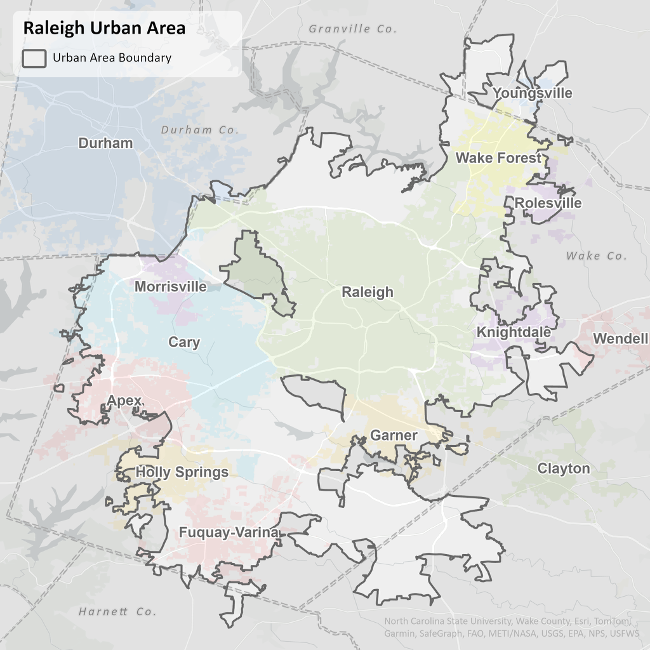
Section 5310 funds can be used for capital and operating expenses to support non-profit organizations, private operators and public agencies providing transportation services to meet the specific needs of elderly persons and persons with disabilities. Requirements are further detailed in the Section 5310 Program Management Plan (PMP). All projects must either have their origin or destination within the Raleigh Urban Area to qualify for Section 5310 Urban Area funds; an origin or destination in a rural area is permitted as long as either the origin or destination occurs within the urban area.
At least 55 percent of the funds given annually (“apportioned”) to any rural, small urbanized, or large urbanized area must be used for public transportation “capital” projects that are planned, designed, and carried out to meet the specific needs of elderly persons and persons with disabilities. These are referred to as “traditional capital projects.” Elderly persons and persons with disabilities must be the primary benefactors of the proposed projects to qualify for Section 5310 project funds; simply benefitting these groups among others is not sufficient.
Eligible projects for the required 55 percent of traditional capital projects include mobility management, the capital cost of contracting for transit services for elderly persons and persons with disabilities and other specialized shared-ride transportation services. Buying rolling stock for or acquiring Americans with Disabilities Act (ADA) complementary paratransit service may also both qualify as eligible capital expenses when public transportation is insufficient, unavailable, or inappropriate, provided these projects are carried out by eligible subrecipients and these projects are included in the area’s Coordinated Public Transit-Human Services Transportation Plan. Refer to Section 7.1 - Traditional Capital Expenses of the PMP for details.
In addition to the required minimum 55 percent of traditional capital projects, up to 45 percent of an area’s apportionment may be utilized for additional public transportation projects that accomplish one or more of the following:
a. Exceed the ADA minimum requirements,
b. Improve access to fixed-route service and decrease reliance by persons with disabilities on ADA-complementary paratransit service, or
c. Provide alternatives to public transportation that assist elderly persons and persons with disabilities with transportation.
Section 5310 funds will only be allocated for projects that meet the specific needs of seniors and individuals with disabilities to be eligible. Refer to section 7 - Eligible Projects in the PMP for further details.
Applicant Toolkit - Click here to view
Visit the applicant toolkit for examples, templates, and other resources needed to successfully prepare your application, execute a grant agreement, and administer your grant.
CONTACT INFORMATION:
Tierra M. Hobley
Fiscal Analyst- Grants
City of Raleigh
Department of Transportation - GoRaleigh
4104 Poole Road, Raleigh, NC 27610
(p) 919-996-4287
Tierra.Hobley@raleighnc.gov